Subscribe to our mailing list below and be the first to know when we launch and also be in with a chance of being one of the first to benefit from this exciting new education initiative.
Keyskills Mailing List
Sign up to get all the latest on Keyskills, powered by the Keystone Group.
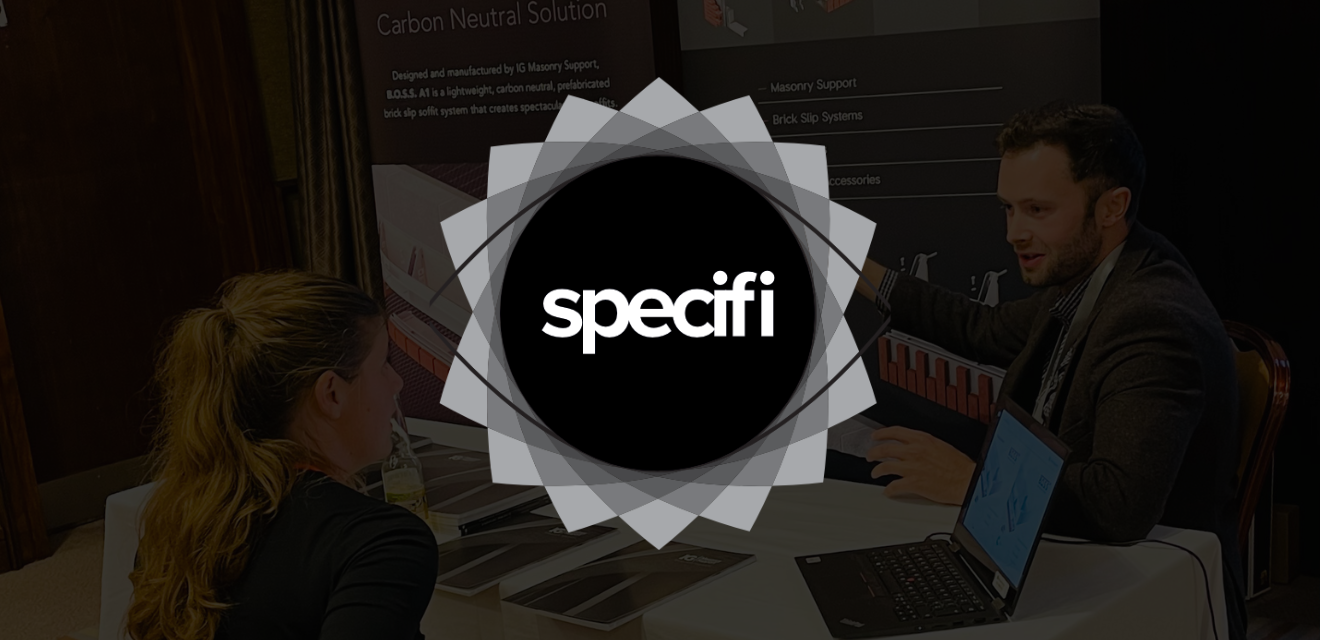
Specifi’s built environment ‘tech-talk’ events are back for 2023 and three of the Keystone Group brands have secured spots at a number of locations throughout the series.
The series of architecture ‘tech-talk’ events bring together architects and industry experts to discuss the latest challenges and trends within the industry. Attendees are allocated 10 minutes with each industry expert to find out more about their products and services.
IG Masonry Support, Keyfix and Keystone Lintels will be in attendance at various locations throughout the year:
30th January – London (Keyfix and Keystone Lintels)
7th February – Manchester (IG Masonry Support and Keystone Lintels)
15th Feburary – Edinburgh (Keystone Lintels)
15th March – Leeds (IG Masonry Support)
17th April – Nottingham (IG Masonry Support)
10th May – Bristol (Keyfix and Keystone Lintels)
12th July – Cardiff (Keyfix and Keystone Lintels)
2nd August – Sheffield (IG Masonry Support)
23rd August – London (IG Masonry Support, Keyfix and Keystone Lintels)
13th September – Birmingham (IG Masonry Support, Keyfix and Keystone Lintels)
25th September – Belfast (Keystone Lintels)
27th September – Dublin (IG Masonry Support and Keystone Lintels)
25th October – Manchester (Keyfix)
15th November – Liverpool (IG Masonry Support)
Event spaces are limited and invite only. If you are interested in attending any of these events, you should register on the Specifi website.
Masonry support systems have been crucial to improvements in both brick building design and safety. However, until IG Masonry Support drove the development of a new and reliable testing regime, assumption played a large part in the specification of ancillary masonry products for UK projects. So, how does IG Masonry Support’s testing system work, and why is there no uniform regulation regarding masonry support products? Emanuele Scarabino, IG Masonry Support’s R&D Manager explains.
It’s very difficult to create a design code for masonry support products that can be shared, acknowledged and absorbed by other countries. In Italy and Spain, for example, masonry soffit systems and the like are not widely used due to brick not featuring as prominently within the architecture. Whilst in Britain and Ireland, where brick facades have been prevalent throughout the built environment for many decades, there has been no compelling reason to introduce regulatory testing guidelines because there have been no major issues with masonry support products in buildings.
Consistency is very important when it comes to the testing and design of building products. Without it, assessment methods and maintenance statements are a thing of individual responsibility. Whilst this approach might satisfy the requirements of one structural engineer, it might not be appropriate for another. Without uniform testing data in place, it leads to assumptions being made on a building product’s projected performance. The absence of such detail could lead to incorrect product specification dramatically increasing the risk of failure.
At IG Masonry Support, we developed a physical testing method to ensure the assumptions we made on our products’ performance were correct. In the five years since we devised the process, we’ve carried out more than 1,000 tests. It means if a consultancy engineer enquires as to why a particular masonry support system needs to allow for a specific deflection, we have the data to support our decision.
Test process
Our physical testing method was developed over several months. It’s carried out using a masonry support testing rig, a 2m x 3m steel structure that simulates the strength and response of a 10-storey building. Assessments take place at Queen’s University Belfast Laboratory using UKAS-accredited machinery. Such facilities are ideal for fulfilling IG Masonry Support’s philosophy: ‘test as much as possible in order to prove the assumptions you make’.
In terms of how we apply loads to assess the masonry support’s ‘real-life’ impact via our testing rig, we undertook finite element analysis (FEA) using three different software, the main two being SolidWorks and ANSYS. Through FEA, we identified how to replicate bricks’ weight and density and the optimum way to load them to the testing rig’s top shelf.
The need to develop products and processes that help improve building standards continues to drive us. Hence, we developed bespoke software which stores all of our test results on a single database. We designed the software to be capable of creating the ideal masonry support solution based on a set of key values including wall cavity, concrete slab height and brick density. As well as giving an accurate prediction of our masonry support system deflection, the software is capable of designing all of the other system values around it – the support’s stainless-steel thickness, for example. Will a 5mm or 4mm angle provide enough capacity? Our software will answer that question too, based on a list of stress checks that also include brackets and a range of general fixings.
The software provides a printout of the design specification of each IG Masonry Support product. From deflection estimation to fixing design, clients are provided with an accurate, reassuring summary of the system’s performance backed by test data. Industry reaction has been very positive about our innovation in masonry support test methodology, with associate engineering consultants telling us the system has instilled an additional layer of trust in IG Masonry Support products, compared to our competitors. But our innovation continues. Since we originated the software in 2018, we have carried out more than 50 updates in order to adapt and refine its performance.
IG Masonry Support’s software package benefits our engineers by bringing uniformity to the masonry support design process. It also helps our clients, as it not only selects the best system from a design perspective, it chooses the most cost-effective solution from all the available structurally-safe masonry support designs. Furthermore, the software package is very good news for the construction industry. It proves that our masonry support products are not assigned on assumptions but they have been physically tested setting the foundation for a process that can only improve building standards in terms of safety and design.
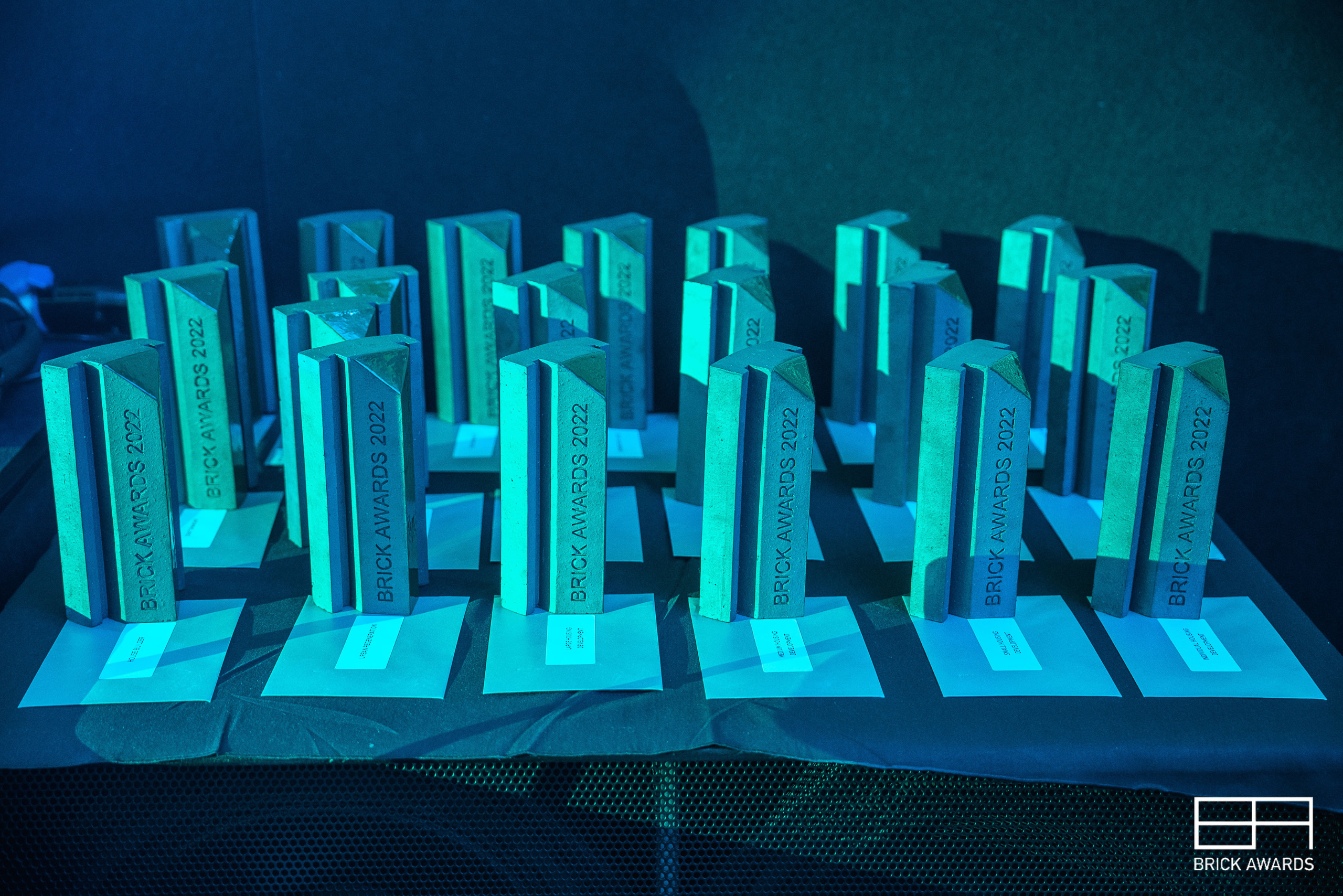
IG Masonry Support is delighted to have produced bespoke masonry support and brickwork solutions to a number of the winners from the Brick Development Association (BDA) Brick Awards 2022.
The Awards, which took place on Thursday 10th November at the Royal Lancaster, London, celebrate the very best examples of clay in the UK’s built environment.
A total of 15 projects shortlisted at the annual awards were supplied with IGMS products and six of these projects won their category or were highly commended including:
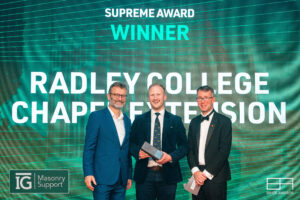
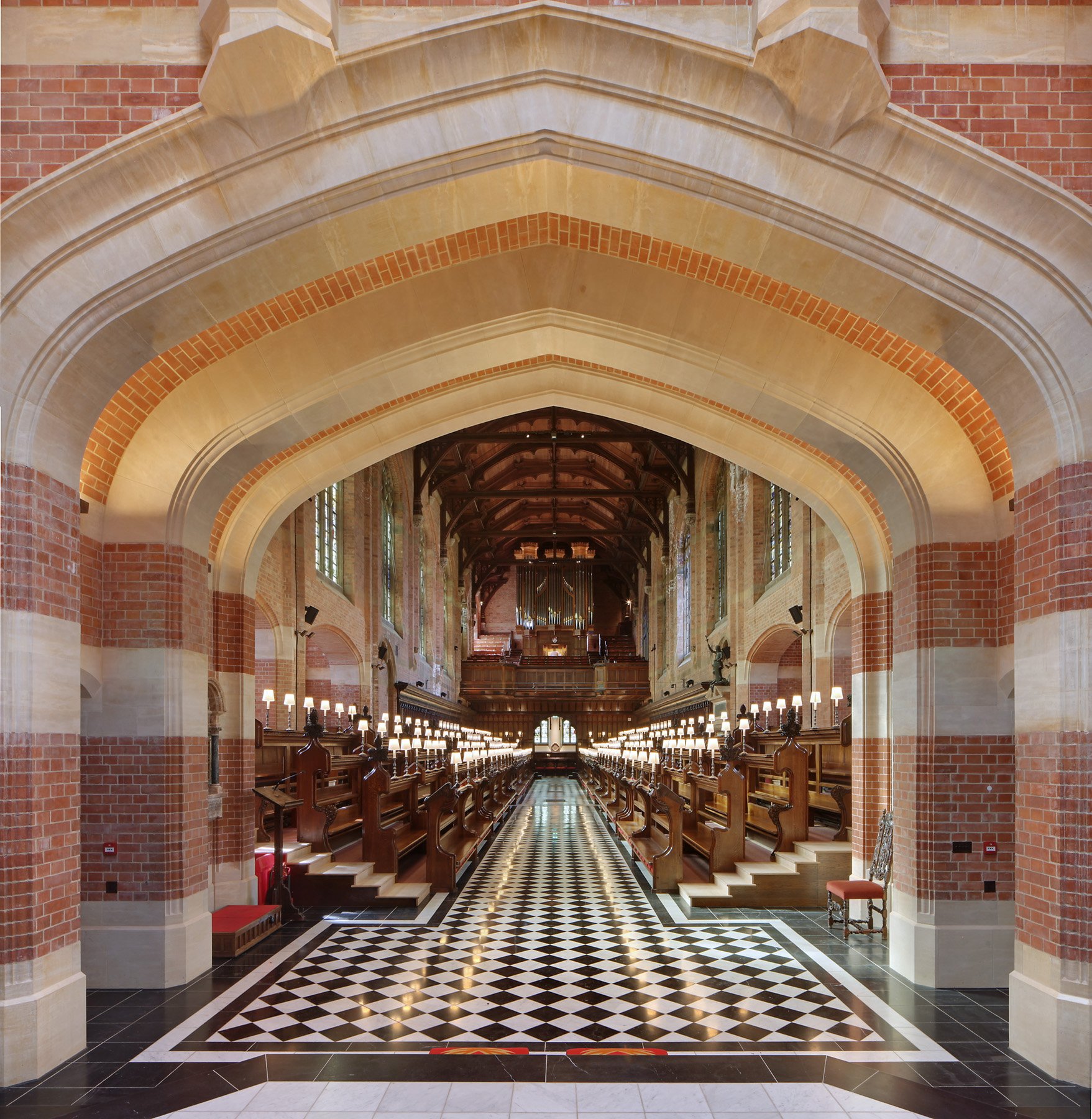
Scott Denham, Sales Director at IG Masonry Support, said: “We are extremely proud to be associated with a number of the projects which were shortlisted and went on to become category winners and highly commended at this year’s Brick Awards. A particular mention goes to the
Supreme Winner, Radley College Chapel Extension. A very deserving winner featuring some of the most detailed arches ever produced by IG Masonry Support.”
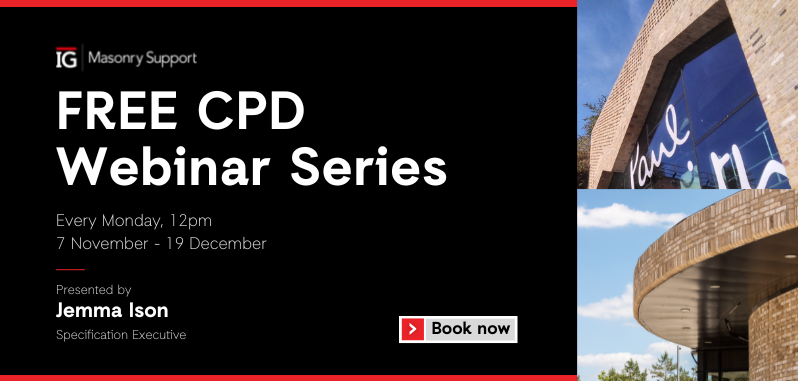
IG Masonry Support Specification Executive, Jemma Ison, will be presenting a host of free CPD webinars developed to educate architects, specifiers and engineers in achieving intricate brick features using masonry support and brick soffit systems and specifying sustainability.
The series will run every Monday from 7th November until 19th December at 12pm with each week focusing on alternative CPD topics.
Topic 1: Achieving Intricate Brick Features (60 mins)
Content includes:
Brick Slip Soffit Systems
Comparing traditional methods of forming brick soffits with new technologies
Bespoke brick slip solutions that comply with Document B: Fire Safety
Brick slip feature arches
Achieving deep brick soffit details which blend seamlessly with brickwork constructed on-site.
Support of Masonry Cladding on Framed Buildings
Supporting masonry above horizontal movement that allows expansion and contraction between primary structure and external leaf
Why material selection is limited to stainless steel for masonry support systems
Levels of adjustability in the different systems to accommodate site tolerances
Designing, selecting and specifying Windposts.
Topic 2: Specifying Sustainability: How off-site construction and conscious material selection promotes the circular economy (30 mins)
Content includes:
An overview of the global challenge and the need to decarbonise our sector
Awareness of the sustainable benefits of off-site construction solutions
Awareness of sustainable materials selection to promote a circular economy
How the Keystone Group is proactively delivering Net Zero applications.
Dates and information
Monday 7th November, 12pm: Achieving Intricate Brick Features
Monday 19th December, 12pm: Achieving Intricate Brick Features
Registration is required and a direct link to the webinar will be forwarded to the email recorded at registration. Attendees will receive a CPD certificate following the session which contributes towards their annual CPD points.
The awards celebrate ‘outstanding quality in the brickwork contracting sector’, which relates to IG Masonry Support as a leading designer manufacturer of advanced stainless-steel masonry support products.
Eve Livett, Association of Brickwork Contractors’ CEO said: “We’re delighted to have IG Masonry Support on board as an award sponsor. I’m aware of how dedicated the company is to improving standards in the brickwork sector with its innovative range of masonry support products. IG Masonry Support’s patronage is also indicative of its belief in ABC’s aim to improve the skillset of the UK’s current and future brick workers.”
Entries to this year’s ABC Awards opened in July. The contest includes five categories, with the winners of each section being announced at a finals evening being held at London’s Royal Horseguards Hotel on Friday, February 24th. It will mark the second time the awards have been held since their inception in 2021.
Scott Denham, Sales Director for IG Masonry Support said: “ABC is doing a superb job in helping to improve the skills of a new generation of brickworkers. The type of training they provide is essential to ensuring products innovated by ourselves and other masonry-based companies are implemented using the highest workmanship. We were more than happy to sponsor the ABC Awards as a show of support for the progress made by their superb learning programme and its trainees.”
Keystone Group announces the launch of Keystone Live this autumn with a series of free webinar debates featuring expert industry speakers. Introducing four separate webinars, the series covers a range of topics and issues including the delivery of net zero housing, offsite construction, designing with non-combustible materials and how the industry is tackling climate change.
The first online debate, ‘How are we going to deliver Net Zero Housing?’, takes place on Thursday 29th September. With the UK facing the ambitious target of being net zero by 2050, the latest changes to Building Regulations are an all-important stepping stone to the Future Homes Standard. But with more stringent standards in the pipeline, is this achievable?
Moderated by experienced journalist Ruth Slavid, this first webinar also poses the following questions:
• How do we address the performance gap?
• How do we build as designed?
• What are the key areas we should be looking at to help improve the fabric of buildings?
• Is the target of 75-80% less carbon emissions from new homes when compared to current regulations achievable?
• How can manufacturers support the drive for net zero?
• What role does product innovation play?
Featuring debate, discussion and Q & A, the webinar has a stellar line-up of industry panellists including Martin Townsend, Director for BSI Centre of Excellence for Sustainability, Ben Cheetham, Senior Group Technical & Innovation Coordinator at Barratt Developments, Robin Dryer, Director and Architect at CDC Studio and representatives from Keystone Lintels and Keylite.
Thursday 3rd November sees the webinar series ask the question: ‘Is the Construction Industry Doing Enough to Tackle Climate Change?’. Will Arnold, Head of Climate Action at Institution of Structural Engineers, Dr Oliver Jones, Research Director at Ryder Architecture and Nitesh Magdani, Director of Net Positive Solutions will offer their insight and perspectives and what we need to do as an industry to slow climate change.
The final webinar on Thursday 16th November, ‘Designing with Non-Combustible Materials‘ will explore the challenges and key considerations when designing tall buildings and how products have evolved to meet new regulations. Ready to share their experience are expert speakers including Richard Smith, Head of Standards, Innovation & Research at NHBC and Nigel Shields, Director of Quality at Durkan.
Keystone Group Marketing Director, Hayley Lowry commented:“The Keystone Live series of webinars explores key themes from various industry standpoints. Debated by commentators, consultants, specifiers, contractors and product specialists — these free events are set to provide a complete 360˚ analysis of the issues at hand and are not to be missed.”
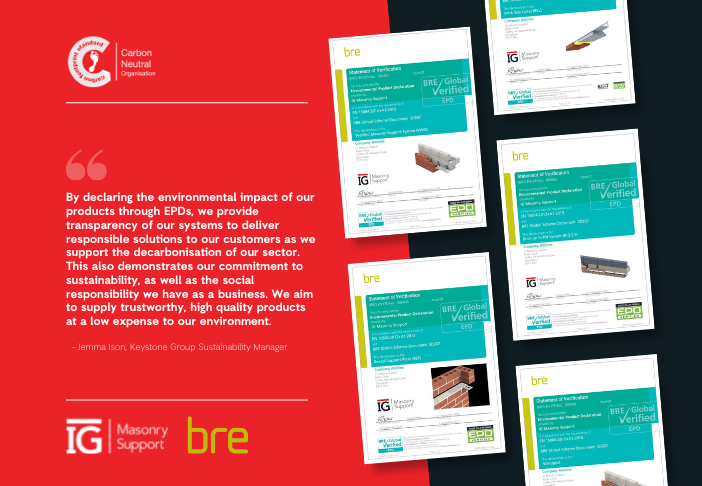
IG Masonry Support has become the first masonry support supplier in the UK to issue Environmental Product Declarations (EPD) on its products according to the GreenBook Live EPD system. This is a significant achievement, demonstrating IG Masonry Support’s commitment to fact-based sustainability reporting and reduced carbon emissions across its business and product range.
An EPD is a document that quantifiably demonstrates the environmental impacts of a product. They are a Type III environmental label. EPD’s are generated based on data obtained through Life Cycle Assessment (LCA). An LCA is performed using a peer reviewed Product Category Rules document (PCR) in line with EN 15804 (the European Standard for the generation of EPD for construction products), ISO 14025, and other related international standards.
The EPDs are registered as part of the EN 15804 EPD Verification Scheme and are recognised by BREEAM (the world’s leading science-based suite of validation and certification systems for sustainable built environment) and the EU’s Green Public Procurement Scheme.
IG Masonry Support is committed to becoming a Net-Zero Carbon business in line with the Science Based Targets Initiative. It is also in the process of submitting its targets for verification and public declaration to reach the global Net-Zero goal.
Jemma Ison, Keystone Group Sustainability Manager said: “By declaring the environmental impact of our products through EPDs, we provide transparency of our systems to deliver responsible solutions to our customers as we support the decarbonisation of our sector. This also demonstrates our commitment to sustainability, as well as the social responsibility we have as a business. We aim to supply trustworthy, high quality products at a low expense to our environment.”
The company is already ISO 14001 certified for Environmental Management, a Carbon Neutral business and is continuously improving sustainable working practices. The next step is to utilise the results from the EPDs to minimise the environmental impact of the company’s full product range. The company is already on track to reduce Scope 1 & 2 emissions by 76% by 2025, and is ambitiously taking strides in tackling Scope 3 emissions.
All IG Masonry Support’s EPDs have been launched in collaboration with the Building Research Establishment (BRE), who are internationally recognised for their expertise in Life Cycle Assessments (LCA) in the construction industry.
The delivery of sustainable buildings has been a focus for many years, writes Andy Neal, Managing Director of IG Masonry Support, but with the UK government requiring the country to be net zero by 2050, the need for the construction industry to improve its emissions output has become more acute.
Whilst buildings that offer low energy in-use are critical, the environmental impact of materials and their production is just as important. If manufacturers are to fully take ownership of their sustainable responsibilities, it will require making a holistic assessment of their overall environmental impact. This includes focusing on their day-to-day production processes, which will play a large part in delivering low carbon buildings of the future. Therefore, committing to a companywide approach, rather than focusing solely on the environmental credentials of its products, is integral to a successful carbon zero strategy.
Taking the initiative for product innovation
IG Masonry Support’s carbon zero programme was set up because we as a company wanted to be recognised as a sustainable organisation in our own right, regardless of what other businesses were doing. But it also dawned on us that manufacturers such as ourselves had a big responsibility to innovate the low carbon products the construction industry needed to increase the carbon efficiency of the UK’s future building stock.
Providing a wider range of sustainable products will give builders greater influence when it comes to the reducing environmental impacts of the properties they are creating. This is far from the case, currently. It’s estimated that even major housebuilders have only 1% control over the building process, because everything they build with is supplied by a host of different sources which vary in sustainable composition and performance. Therefore, to build with greater efficiency and consistency, construction companies need to engage with responsible sustainable manufacturers, who in-turn need to innovate products that result in less environmental impact. Improving building sustainability isn’t a standalone exercise. Individual companies have the capability to control the eco-friendly aspect of their business and products. Ultimately, however, it’s the responsibility of the building supply chain to innovate solutions that provide end users with the best possible chance of creating sustainable buildings.
Sustainable steps
The first major steps in our sustainability journey were taken when we switched to 85% recycled stainless steel and reduced our landfill waste to 0% in 2018. We have continued to take leaps towards achieving our ambitions and more recently became a carbon neutral organisation. This was achieved by enlisting the services of an external body (Carbon Footprint) whose initial task was to clarify how far short we were from our target. Following this assessment, we embarked on an offsetting programme to reduce the business’s CO2 emissions. We further reduced our emissions footprint by changing to a ‘green’ utility supplier and swapping our diesel trucks for an electric fleet. Furthermore, our purchase of less energy intensive fibre laser cutting machinery has also reduced our material waste.
The introduction of our carbon neutral programme coincided with the launch of our B.O.S.S A1. an ultra-lightweight brick on soffit system. As a component building part, its carbon neutral status was important to us. Its certification soon led to the company’s carbon neutral classification in June 2021. Achieving this required us to do our homework to fully establish what carbon neutrality actually consisted of, as well as understand the legislation behind it. For this we recruited a Sustainability Manager from within the company. Having a staff member being trained by external bodies to ensure companies within our group were fully-versed in carbon neutral legislation was an important step for us. Our Sustainability Manager now heads-up a team of volunteer staff who meet weekly to discuss ways in which we can progress our net zero ambition.
In terms of our offsetting initiative, rather than simply plant trees, we’ve invested in long-term sustainability energy programmes. Hence, our commitment to wind and solar schemes. Through our acquisition of a gap analysis template, we hope to demonstrate how such schemes are significantly reducing our offsetting requirement less and less each year.
Following the science
Our actions do not stop there, however. We are following Science-Based Targets Methodology, which has achievement parameters of between five and 15 years into the future. This process is being carried out alongside our collaborative workshops with the British Standards Institution, which have helped sculpt a sustainable culture into IG Masonry Support. It’s helped formed an approach to sustainability that focuses on optimising our social, financial and intellectual capital, as well as our environmental wealth. These key elements ensure our strategy is inclusive, reflects our company values and importantly, will be successful. It is our mid-term aim to reduce our Scope 1 and Scope 2 emissions by 76% which covers direct emissions from owned or controlled sources, and indirect emissions from the generation of purchased electricity, steam, heating and cooling consumed by the reporting company, respectively.
I believe we attained carbon neutral status sooner than anticipated because of the company’s inherent desire to do the right thing, rather than wait to have measures forced upon us. Whether it’s achieving ISO 9001 certification or matters related to any form of industry compliance, our approach is always the same. We don’t carry out these processes as a box ticking exercise by rushing to get all the paperwork the day before the auditor comes in. We have a dedicated sustainability team set up who are passionate about driving this forward. We do it properly because we want to advance our business’s carbon zero status, the quality of our product and help facilitate a sustainably-built environment for future generations to enjoy.
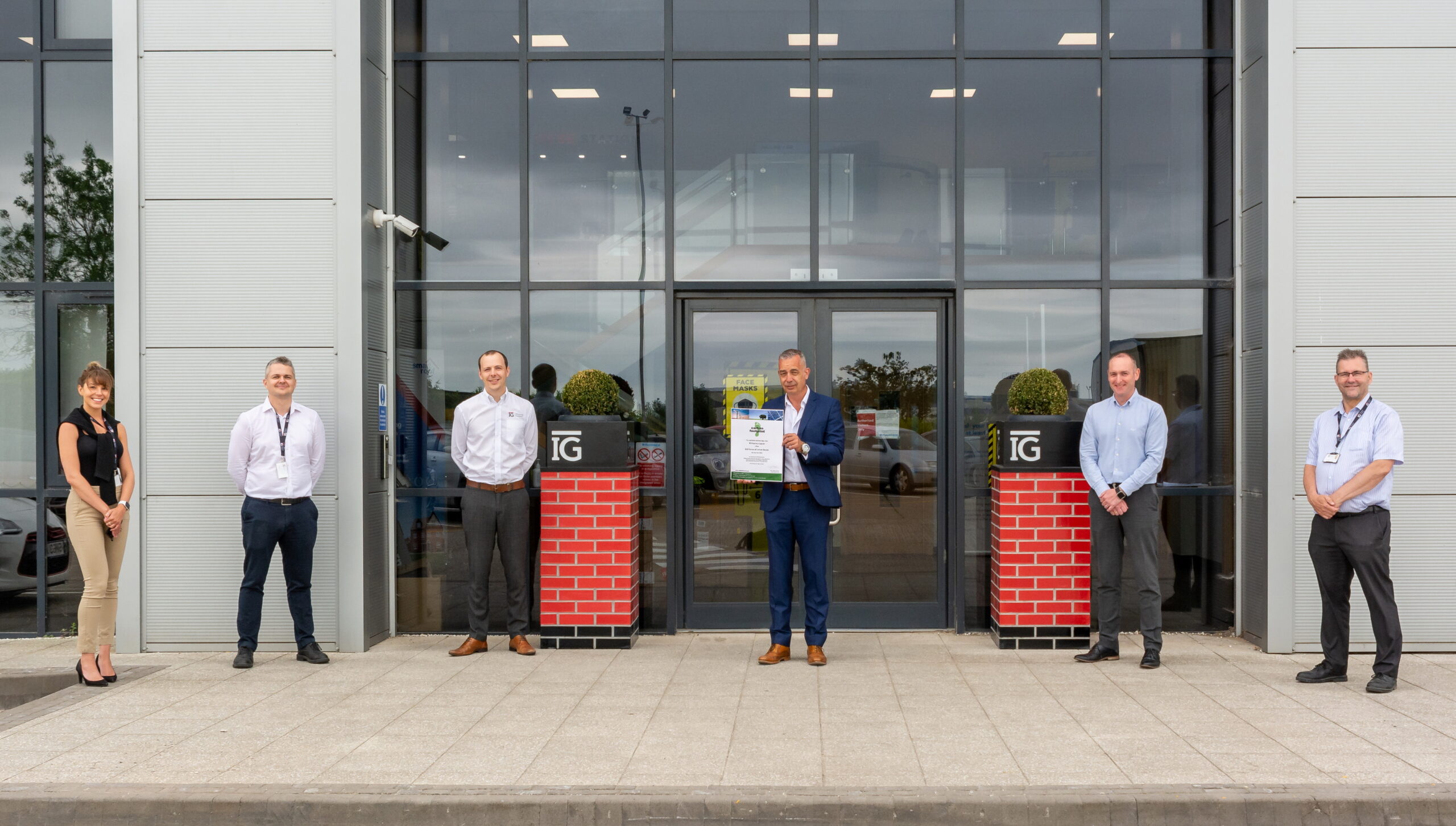
Photo caption: IG Masonry Support achieve Carbon Neutral Status (Left to right) Jemma Ison (Keystone Group Sustainability Manager), Kyle Alexander (Project & Engineering Manager), Andy Sharlot (Chief Designer), Andy Neal (Managing Director), Oliver Ball (Operations Manager) and Stephen Jennings (Financial Controller).
We value your privacy
We use cookies on our website to give you the most relevant experience by remembering your preferences and repeat visits. By clicking “Accept”, you consent to the use of ALL the cookies. However you may visit Cookie Settings to provide a controlled consent.
This website uses cookies to improve your experience while you navigate through the website. Out of these cookies, the cookies that are categorized as necessary are stored on your browser as they are essential for the working of basic functionalities of the website. We also use third-party cookies that help us analyze and understand how you use this website. These cookies will be stored in your browser only with your consent. You also have the option to opt-out of these cookies. But opting out of some of these cookies may have an effect on your browsing experience.
Necessary cookies are absolutely essential for the website to function properly. These cookies ensure basic functionalities and security features of the website, anonymously.
Cookie
Duration
Description
cookielawinfo-checkbox-advertisement
1 year
Set by the GDPR Cookie Consent plugin, this cookie records the user consent for the cookies in the "Advertisement" category.
cookielawinfo-checkbox-analytics
11 months
This cookie is set by GDPR Cookie Consent plugin. The cookie is used to store the user consent for the cookies in the category "Analytics".
cookielawinfo-checkbox-functional
11 months
The cookie is set by GDPR cookie consent to record the user consent for the cookies in the category "Functional".
cookielawinfo-checkbox-necessary
11 months
This cookie is set by GDPR Cookie Consent plugin. The cookies is used to store the user consent for the cookies in the category "Necessary".
cookielawinfo-checkbox-others
11 months
This cookie is set by GDPR Cookie Consent plugin. The cookie is used to store the user consent for the cookies in the category "Other.
cookielawinfo-checkbox-performance
11 months
This cookie is set by GDPR Cookie Consent plugin. The cookie is used to store the user consent for the cookies in the category "Performance".
CookieLawInfoConsent
1 year
CookieYes sets this cookie to record the default button state of the corresponding category and the status of CCPA. It works only in coordination with the primary cookie.
rc::a
never
This cookie is set by the Google recaptcha service to identify bots to protect the website against malicious spam attacks.
rc::c
session
This cookie is set by the Google recaptcha service to identify bots to protect the website against malicious spam attacks.
viewed_cookie_policy
11 months
The cookie is set by the GDPR Cookie Consent plugin and is used to store whether or not user has consented to the use of cookies. It does not store any personal data.
Functional cookies help to perform certain functionalities like sharing the content of the website on social media platforms, collect feedbacks, and other third-party features.
Cookie
Duration
Description
yt-remote-cast-available
session
The yt-remote-cast-available cookie is used to store the user's preferences regarding whether casting is available on their YouTube video player.
yt-remote-cast-installed
session
The yt-remote-cast-installed cookie is used to store the user's video player preferences using embedded YouTube video.
yt-remote-connected-devices
never
YouTube sets this cookie to store the user's video preferences using embedded YouTube videos.
yt-remote-device-id
never
YouTube sets this cookie to store the user's video preferences using embedded YouTube videos.
yt-remote-fast-check-period
session
The yt-remote-fast-check-period cookie is used by YouTube to store the user's video player preferences for embedded YouTube videos.
yt-remote-session-app
session
The yt-remote-session-app cookie is used by YouTube to store user preferences and information about the interface of the embedded YouTube video player.
yt-remote-session-name
session
The yt-remote-session-name cookie is used by YouTube to store the user's video player preferences using embedded YouTube video.
ytidb::LAST_RESULT_ENTRY_KEY
never
The cookie ytidb::LAST_RESULT_ENTRY_KEY is used by YouTube to store the last search result entry that was clicked by the user. This information is used to improve the user experience by providing more relevant search results in the future.
Performance cookies are used to understand and analyze the key performance indexes of the website which helps in delivering a better user experience for the visitors.
Analytical cookies are used to understand how visitors interact with the website. These cookies help provide information on metrics the number of visitors, bounce rate, traffic source, etc.
Cookie
Duration
Description
_ga
1 year 1 month 4 days
Google Analytics sets this cookie to calculate visitor, session and campaign data and track site usage for the site's analytics report. The cookie stores information anonymously and assigns a randomly generated number to recognise unique visitors.
_ga_*
1 year 1 month 4 days
Google Analytics sets this cookie to store and count page views.
_gat_UA-*
1 minute
Google Analytics sets this cookie for user behaviour tracking.
_gid
1 day
Google Analytics sets this cookie to store information on how visitors use a website while also creating an analytics report of the website's performance. Some of the collected data includes the number of visitors, their source, and the pages they visit anonymously.
Advertisement cookies are used to provide visitors with relevant ads and marketing campaigns. These cookies track visitors across websites and collect information to provide customized ads.
Cookie
Duration
Description
VISITOR_INFO1_LIVE
6 months
YouTube sets this cookie to measure bandwidth, determining whether the user gets the new or old player interface.
VISITOR_PRIVACY_METADATA
6 months
YouTube sets this cookie to store the user's cookie consent state for the current domain.
YSC
session
Youtube sets this cookie to track the views of embedded videos on Youtube pages.
yt.innertube::nextId
never
YouTube sets this cookie to register a unique ID to store data on what videos from YouTube the user has seen.
yt.innertube::requests
never
YouTube sets this cookie to register a unique ID to store data on what videos from YouTube the user has seen.