GUEST BLOG | Building Confidence in Fire Safe High-Rise Design

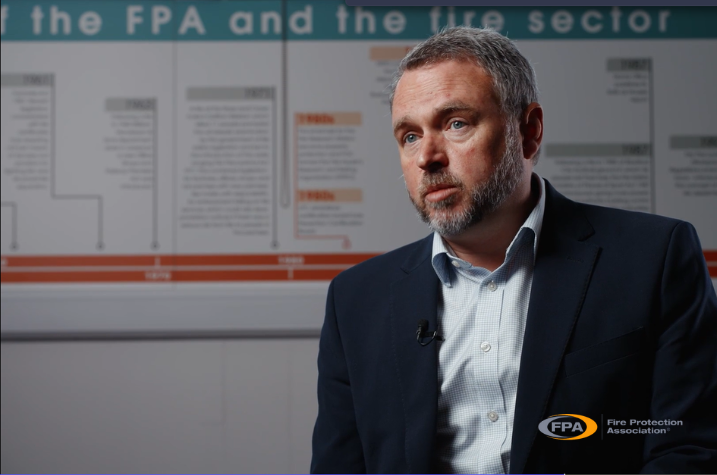
Gavin Dunn, Chief Executive of the UK Fire Protection Association (FPA)

Recent changes to building regulations have brought a much greater emphasis on fire safety across all types of buildings, but particularly for high-rise residential buildings. The sector is now taking a more risk-averse approach to material specification and system design, which means the products we choose, the way we use them, and the way we evidence their performance are under far greater scrutiny than ever before.

The Fire Protection Association (FPA) is a non-profit organisation, owned by the UK insurance industry and the National Fire Chiefs Council. Our sole purpose is to help industry, construction, and property owners reduce risks within their portfolios, both from fire and wider resilience issues. We see first-hand how changes in regulation, oversight, and market expectations are reshaping how the industry designs, builds, and maintains high-rise buildings.

New regulatory framework

The Building Safety Act, the creation of the Building Safety Regulator, and the requirement for the “golden thread” of information have fundamentally changed the regime for higher-risk residential buildings. These projects now follow a formal gateway process. Gateways 1,2 and 3 are essentially planning, construction and before occupation with regulator sign-off being required at each stage before the project can progress.

For those involved in design and specification, this means that products must have proven performance and are tested and certified to relevant standards for their intended use. It’s fundamental that any change such as using products differently from their original specification or in combination with other products that weren’t originally envisioned, the information is reported back to the design team who must then check that these products are still safe, appropriate and compliant. Additional checks such as engineering reviews or new fire tests are essential to confirm they remain safe and compliant. It might also need regulator sign off as well.

The shift to non-combustible materials

Following Grenfell Tower and other fires internationally, the specification of combustible materials, particularly in facade systems, has come under intense scrutiny. There has been a significant shift in market expectations, with insurers, investors, and end users showing a strong preference for non-combustible materials in high-rise buildings.

This change is about more than just meeting regulatory requirements. It is also about reducing reputational risk, protecting public trust, and ensuring the long-term safety of buildings. Non-combustible materials offer the most straightforward route to achieving these goals, giving greater confidence in both compliance and performance.

Testing, verification, and installation

As an industry, we must move beyond simply selecting compliant products. Correct usage and installation are equally critical. Too often, the right products are specified but installed incorrectly, and the data shows that poor installation is currently our biggest failure point.

That is why additional verification steps are so important. Increasingly, products are being tested not just for certification, but for wider or combined uses. This data provides fire engineers with the evidence they need to make sound judgements. In parallel, inspection processes on site must confirm that products are installed exactly as intended.

The importance of the golden thread

The products chosen, how they are used and how they are installed must be documented as part of the golden thread of information. It becomes the single source of truth when it comes to a building. This provides a detailed and accessible record for future owners and operators, ensuring they have the knowledge needed to make safe, informed decisions about maintenance or alterations. Without this transparency, public confidence in building safety will remain fragile.

Looking ahead

The initial industry response to the new regulatory regime has been to specify non-combustible materials wherever possible, and this has been the right approach to rebuild trust. Over time, as testing regimes, certification processes, and regulatory oversight continue to strengthen, we may reach a point where certain combustible materials can be reintroduced in very controlled and well-evidenced ways.

Until then, prioritising proven, non-combustible systems remains the most risk-averse and publicly acceptable choice. Manufacturers such as IG Masonry Support play a vital role in this, providing A1-rated, fully tested solutions and the technical expertise to ensure they are specified and installed correctly.

The challenge now is to maintain our focus on what matters most: delivering buildings that perform in the way society needs them to perform. It is really important that we re-establish public trust and we build buildings that perform in the way society needs them to perform. That means creating buildings that are healthy, energy efficient and great places to live, while also giving people the peace of mind that they are safe and secure when things go wrong.
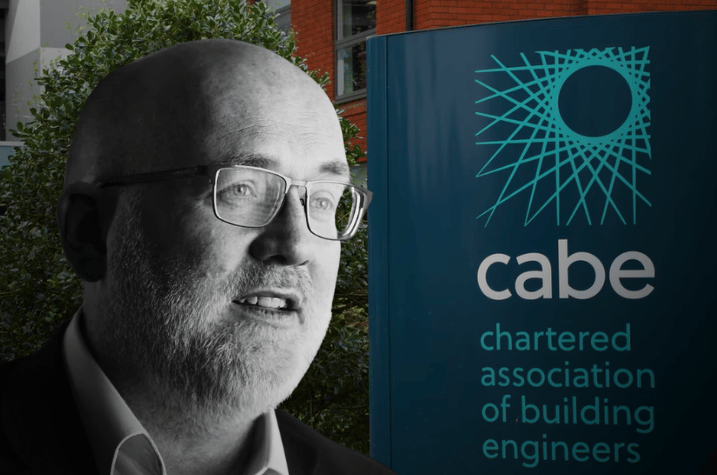

 

GUEST BLOG | Building Safer Outcomes, Not Just Better Buildings

By Richard Harral, Chief Executive Officer at Chartered Association of Building Engineers (CABE)

The drive to deliver safer buildings has never been more important, or more urgent. At Chartered Association of Building Engineers (CABE) we are a multidisciplinary Professional Engineering Institute with a Royal Charter.

Our members work across the full project lifecycle, and we are an active and engaged community, deeply committed to improving the built environment, and, above all, to making buildings safer for the people who use them.

There’s a growing consensus in the industry as to where we need to end up in terms of safety. We need to ensure that everyone involved in designing, specifying, constructing and maintaining buildings is assessed for competence and that there is a clearly defined understanding what they can and cannot do safely. The truth is our industry has not always done this well. In fact, competence has often been managed in a patchy, inconsistent way, or sometimes not at all.

It is no longer acceptable to claim that a person, system or product can be trusted simply because we believe that is the case. In particular, third-party testing of products becomes fundamental, not only in enabling designers to have confidence in what they are specifying, but also to help rebuild trust in a broader sense; that the products are going to deliver the safe outcomes people quite rightly expect.

This means that we have to move beyond minimum standards of compliance. It’s critical that product and system manufacturers and everyone in the industry starts to look at how they deliver the right outcome, rather than simply box ticking to secure sign off from building control or any other authority.

This is why the new competence frameworks that are being developed by the Industry Competence Steering Group (ICSG) and BSI, and the new ways of applying them, are so valuable. One good example of these new standards is  BS 8670-2, a companion to BS 8670-1, which is the core criteria for building safety and competence frameworks. While Part One sets our general principals, Part Two focuses on construction products and sets out what competencies people need have to be able to specify, use, install, maintain and manage construction products to ensure the right outcomes.

The shift towards competency based systems will help continuously upskill our industry. It will encourage people to seek out learning that’s directly relevant and applicable and focuses on maintaining competence throughout their career. In relation to construction products, this will be vital in helping everyone make better decisions throughout the life of a building.

The Building Safety Act (2022) has changed people’s accountabilities; and the timescales in which they can be held to account. This means that in addition to focusing on safe outcomes, everyone has to be more mindful about how they can defend their decisions if something does go wrong.

The advice we give is simple: when in doubt, apply the precautionary principle. What does that mean in practice? It means utilising systems and approaches that you know, understand and trust. It means adding extra levels of mitigation to ensure higher degrees of certainty that the systems and products you are using are going to perform as expected, throughout the lifecycle of the building.

It’s important that construction professionals, building users and the residents who they serve have peace of mind and confidence that the right outcomes are being achieved in a context where buildings are becoming increasingly complex, we are asking them to perform to higher standards over time, both in terms of safety and energy efficiency. The only way that we are going to achieve this peace of mind is if we think differently about how we design and specify.

That means taking a holistic view of building performance. We have to consider how each element will perform in relation to and in combination with others, rather than looking at a single product’s conformity. We must also look at additional levels of mitigation where we have any concerns, or doubts, about the overall performance of the building when it’s actually in use.

This definitely means leaning to a greater extent on third-party certification and testing of both products and systems – and increasing the number of systems that are tested at scale. It may also mean narrowing the supply chain we use so that we work with products and systems on a more frequent basis. We must become more familiar and confident in the way that they perform and in the way that we need to use them.

This is where manufacturers have a critical role to play, by providing tested, well-documented solutions and the technical support that helps designers and contractors specify with confidence. IG Masonry Support clearly understand this imperative, and it is great to see the investment they are making in helping delivery better quality and safer outcomes.

At CABE, we are committed to working with proactive professionals to, help build a safe, sustainable and equitable built environment. This is important to our members, who are professionals with a real passion for the work that they do. It’s also fundamental to ensuring that people are safe, and feel safe in the homes and workplaces that matter to them.


NEWS | IG Masonry Support shapes landmark Lambeth Mission with Brick Slip Arches

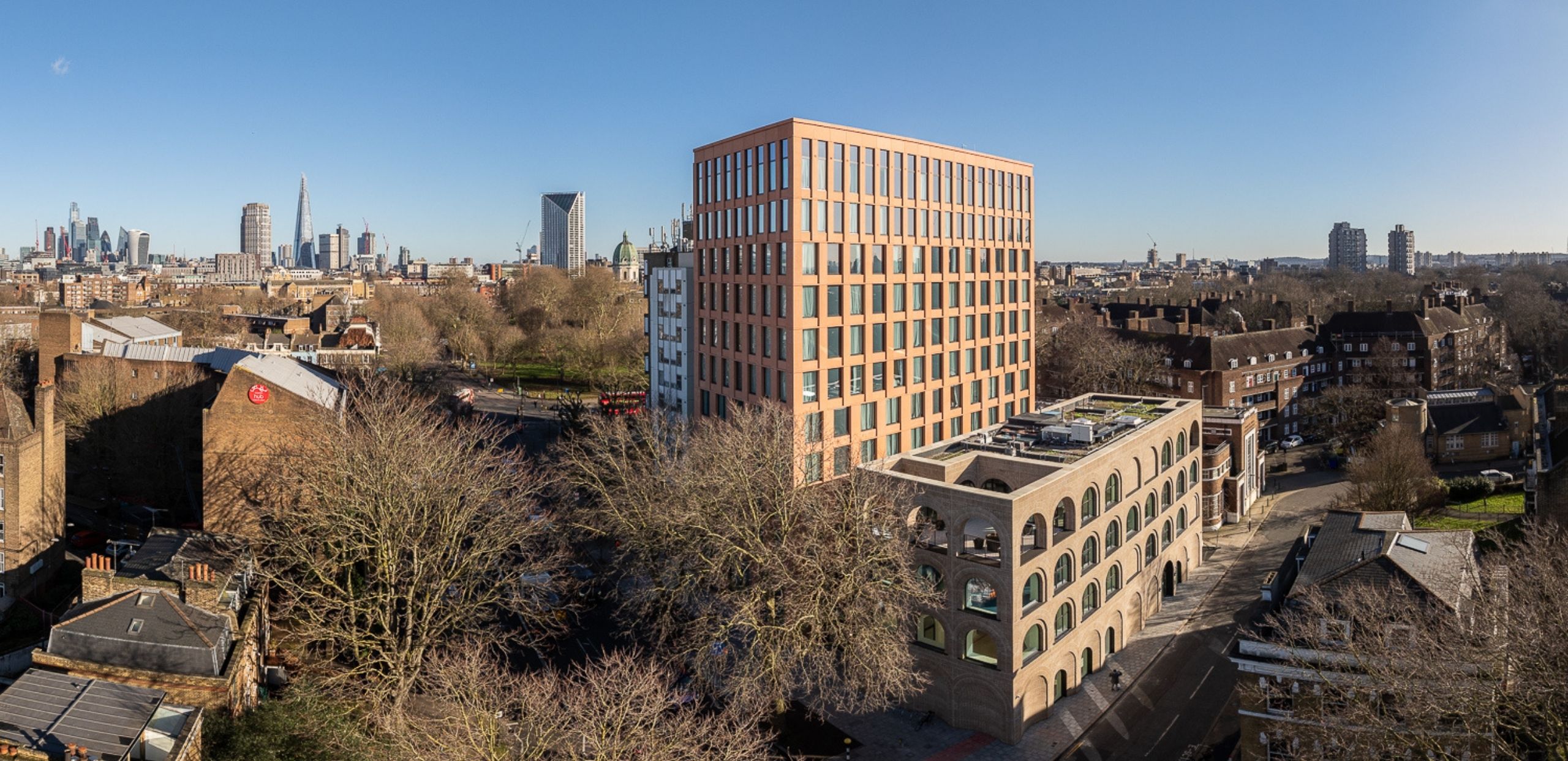
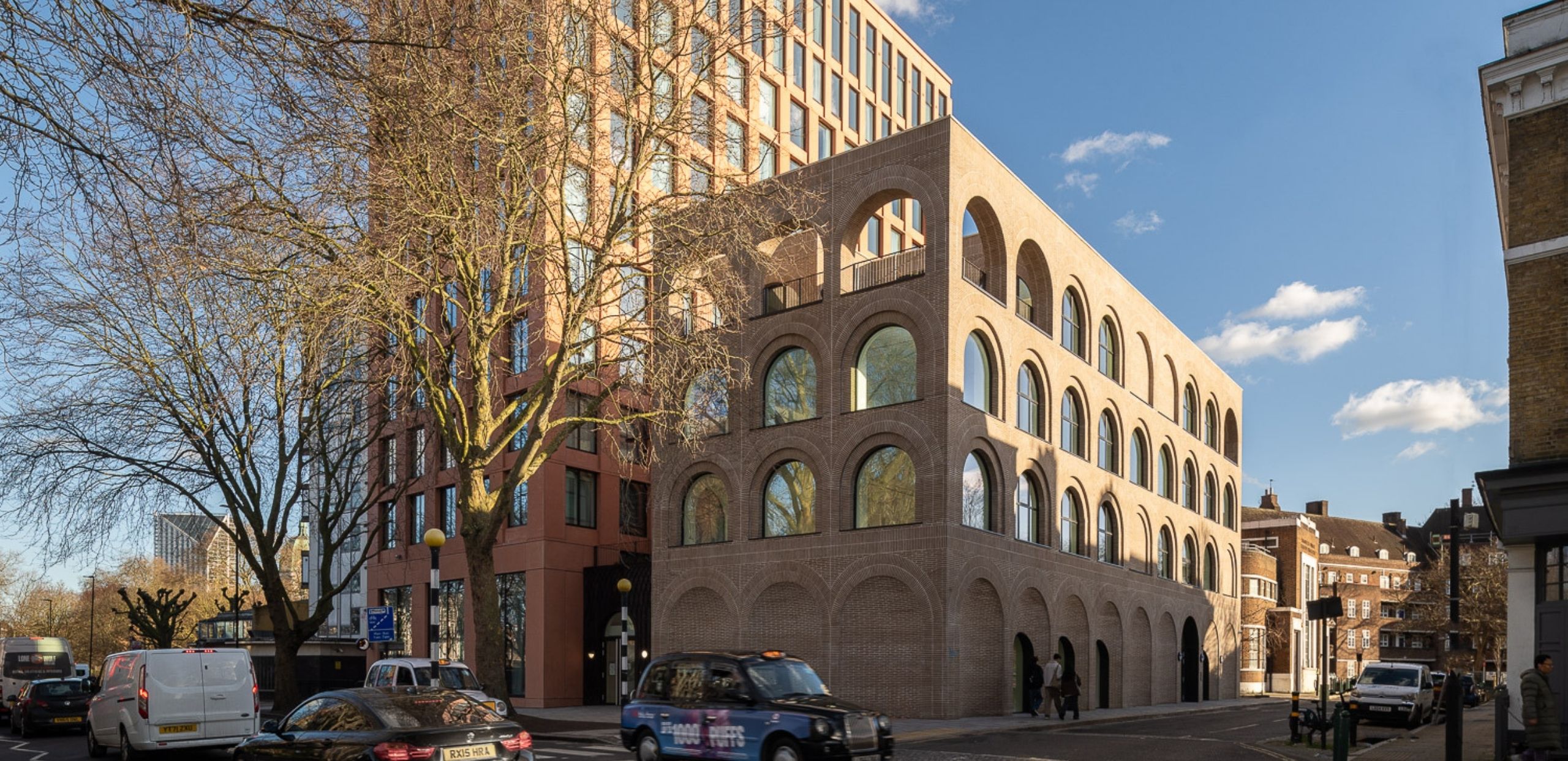
IG Masonry Support played a key role in the successful delivery of Lambeth Mission, a striking mixed-use development in the heart of London, featuring a complex arrangement of bespoke Brick Slip Arches that were designed and manufactured to achieve a seamless hand-laid appearance.

Located opposite the Grade II-listed Imperial War Museum, this high-profile scheme includes a 12-storey, 137-bedroom hotel, modern community facilities, and two residential apartments for the Methodist Church. Working in close collaboration with Aros Architects, HG Construction, and brickwork specialists Bishop Ltd, IG Masonry Support designed and manufactured 105 bespoke Brick Slip Arches and more than 120 metres of Welded Masonry Support to meet the project’s structural and aesthetic demands.

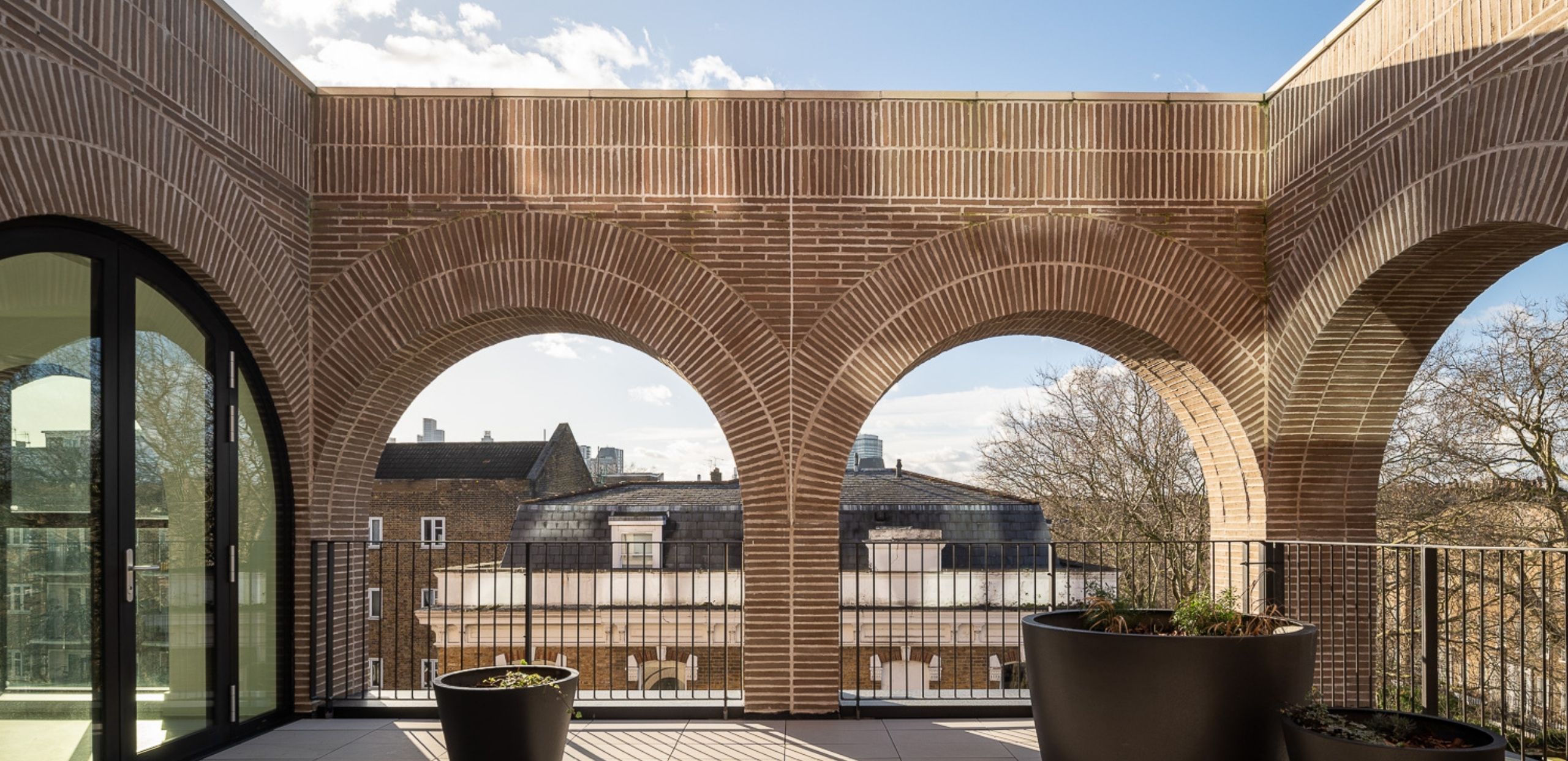
One of the most technically challenging aspects of the build was achieving perfect alignment between multiple intersecting arches, especially around the terrace area, which featured 10 interconnected arches, including five internal and one external corner. Each element had to connect precisely while accommodating structural movement joints. IG’s design team developed custom templates and a series of test arches to ensure brick placement remained accurate and visually seamless across every elevation.


The handmade bricks chosen for the project presented another hurdle. With their natural bowing, irregular sizes and rough edges, they were difficult to cut and align but were essential to achieving the architect’s vision of a traditional hand-laid finish. Using bricks sourced directly from site, IG’s team embraced these imperfections, crafting units in a factory-controlled setting that replicated the authenticity of onsite masonry while saving time and labour.

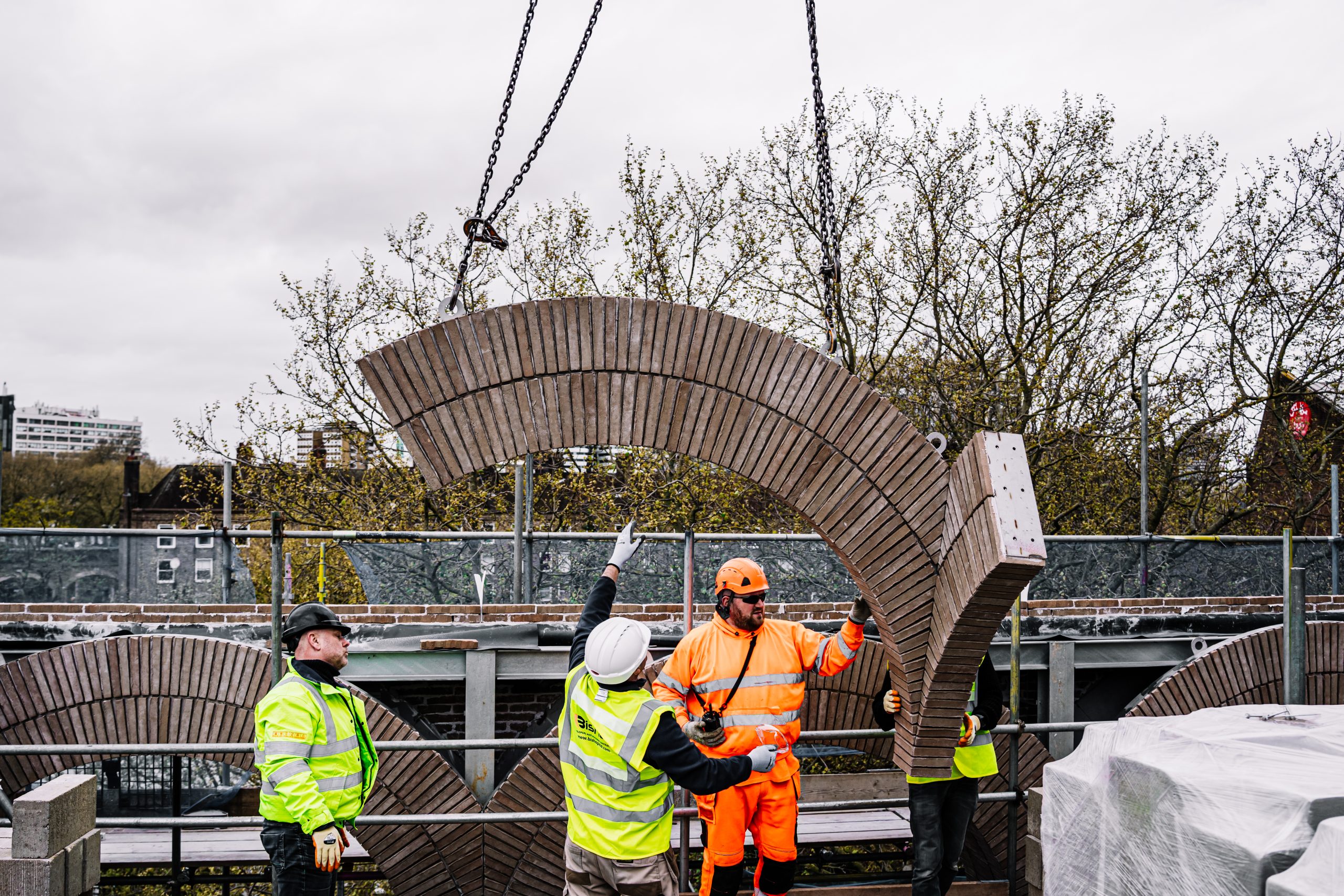
The Brick Slip Arches and Welded Masonry Support were engineered to bolt directly to the steel structure, accommodating varying cavity widths and complex junctions. Deep soffit units were fabricated in two parts to work around the steel perimeter, with joints carefully pointed onsite to create an uninterrupted appearance.

“We approached IG in the first instance because of their known expertise in delivering high-quality masonry support solutions, said Natasha Coutts, Associate at Aros Architects. “They were the first people that we approached, and the only people that we approached. From the very first meeting, it was clear they would be the right fit.”

Antony Dixon, Site Manager at Bishop Ltd, added:
“Their engineers were onsite for the installation of the first arch. Whenever I needed support, a quick phone call was all it took. They helped us keep the project moving forward.”

By combining design expertise with off-site precision, IG Masonry Support helped bring Lambeth Mission’s bold architectural vision to life, successfully delivering complex masonry solutions that look as if they were crafted entirely by hand. The result is a standout project that blends modern construction with traditional detailing, and once again highlights IG’s commitment to quality, collaboration, and innovation.

BLOG | In-house Manufacturing Drives Quality and Efficiency


With brick facades as popular today as they have ever been, building designers and specifiers need to be confident the products they specify will achieve the same exceptional finish each and every time. Taking the construction of complex brick features offsite into factory-controlled conditions, how do offsite manufactured solutions fulfil complex and creative requirements in buildings whilst hitting the mark on quality and meeting regulatory compliance?

 At IG Masonry Support, we are committed to delivering the highest quality brick slip and masonry support solutions for our customers. Quality is at the heart of everything we do, from our innovative product design to our rigorous manufacturing processes.  This commitment is backed by internationally recognised certifications for our facilities including ISO 9001, along with BBA product approval, reinforcing our focus on robust quality management and environmental responsibility.

The company goes further by using UKAS-accredited equipment from Queen’s University Belfast and partnering with respected independent testing facilities such as Warrington fire, Lucideon, Efectis, and SGS, rigorously verifying hygrothermal performance, fire resistance, deflection, and adhesion. This comprehensive approach to product validation underpins the confidence that designers, contractors, and regulators place in our solutions.

 At the heart of this is IG’s B.O.S.S. A1 (Brick on Soffit System), the first brick soffit system on the market to comply with and exceed the new A1 fire regulations. By combining adhesives with mechanical fixing, B.O.S.S. A1 delivers the exacting performance and safety standards demanded, while being the first product of its kind to be carbon neutral. Its impressive credentials, all of which are BBA certified, offer a technically advanced solution that meets the required aesthetics by hiding structural steelwork to give the illusion of unsupported brickwork.


Precision brick matching

Ensuring a seamless, authentic look is crucial for our brick slip solutions. That’s why we manufacture all our products, including B.O.S.S. systems, in our in-house Brick Fabrication Facility in Overseal, Derbyshire. Our design engineers work closely with customers to identify the exact brick type, shape, and bond pattern required, using free-issue bricks from the live site. This meticulous process allows us to achieve a perfect match and integration with the surrounding brickwork.

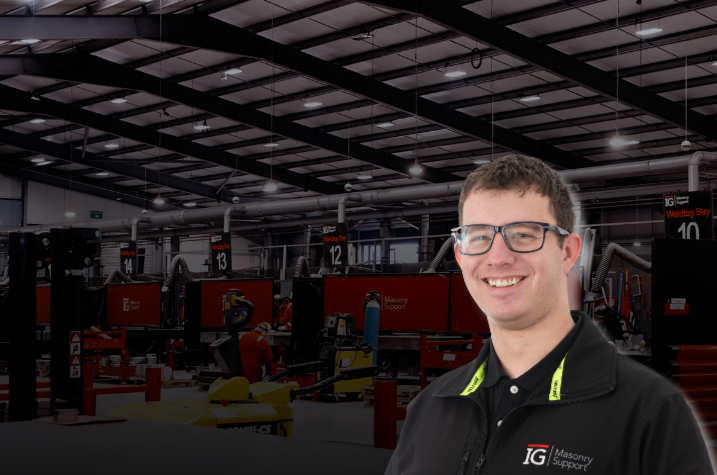
To support our dedication to quality, we have invested heavily in our Swadlincote and Overseal production facilities. These state-of-the-art factories utilise the global 5S system to optimise productivity and reduce waste, while being home to cutting-edge machinery, including robotic lasers, press brakes, and stacking machines.

Brick remains a timeless material that future generations will continue to rediscover, ensuring its enduring place across our built environment. Moving the construction of complex brick features offsite into factory-controlled settings means, we can achieve the level of quality and consistency that excellence demands. This is due in part to companies such as ours and a commitment to developing solutions that enable brick, a cornerstone of construction, to be used in ways that inspire the imagination of architects and builders alike.


GUEST BLOG | Building Safety Act: Why Competence, Testing and Trust Are Non-Negotiable

An interview with Richard Harral, Chief Executive of the Chartered Association of Building Engineers (CABE)

As the construction industry continues its journey towards safer, more accountable practices, the message from regulatory bodies and professional institutes is increasingly clear: compliance alone is no longer enough.

In a recent conversation with IG Masonry Support, Richard Harral, Chief Executive of the Chartered Association of Building Engineers (CABE), shared his perspective on how the industry must evolve to meet the expectations of the Building Safety Act — and why this shift demands a fundamental rethinking of how we define and demonstrate competence.

CABE, a global professional engineering body, is championing a culture of lifelong learning and accountability. With the introduction of frameworks like BS 8670-1 and 8670-2, there’s now a sharper focus on the specific skills and understanding required to correctly specify, install, and manage construction products — from brick support systems to full envelope solutions.

Richard also highlights the critical importance of manufacturers in this process. By providing independently tested and clearly documented solutions, manufacturers help close the trust gap and enable designers, specifiers, and contractors to make confident, compliant decisions.

At IG Masonry Support, we’re proud to play our part. From our TITAN and B.O.S.S. products to our technical support and CPD offerings, we help ensure that performance, testing, and compliance are not afterthoughts — but core to specification decisions from the outset. We’re proud to be part of a safer, more competent built environment.

Watch the full interview with Richard Harral to explore how safety, trust, and responsibility are reshaping the future of construction.

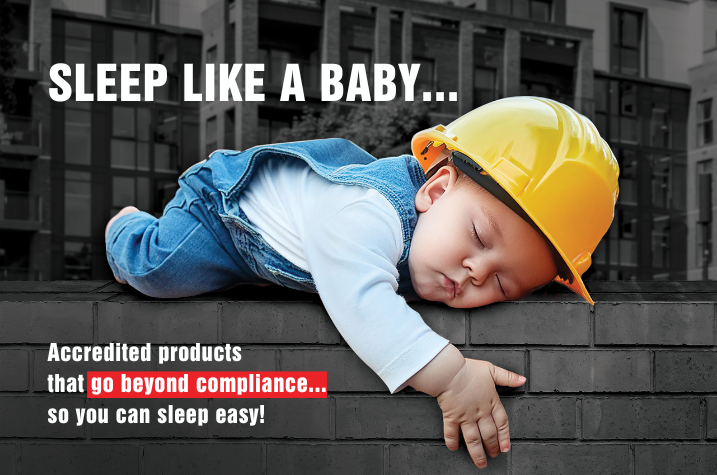
NEWS | ‘Sleep Like A Baby’ campaign launches to champion Building Safety Act compliance

IG Masonry Support is proud to launch our innovative ‘Sleep Like a Baby’ campaign to highlight our company’s unwavering commitment to Building Safety Act compliance, in-house manufacturing excellence and high-quality, accredited products.

Aimed at architects, specifiers and contractors, the campaign showcases our comprehensive approach to quality assurance and safety, backed by numerous industry accreditations and certifications. Operating from our state-of-the-art manufacturing facility in South Derbyshire, our company maintains complete control over production quality through in-house manufacturing processes and rigorous testing protocols.

In a new era of accountability, the campaign cements our reputation and commitment to supporting stakeholders throughout the entire project lifecycle, from initial design and specification through to completion. By maintaining strict control over the manufacturing process and investing in extensive testing and certification, we ensure our masonry support and brick slip products not only meet but exceed current building regulations and safety standards.

Key features that set us apart include:

Commenting on the launch of the campaign, Andy Neal, Managing Director of IG Masonry Support, said: “The Building Safety Act has raised the bar for construction product manufacturers, and rightly so. It is critical that building products are specified for their purpose and manufactured to perform exactly as intended.  Our ‘Sleep Like a Baby’ campaign reflects our absolute confidence in the quality and safety of our products. When specifiers and contractors choose IG Masonry Support, they’re choosing peace of mind.”

The launch of this campaign reinforces IG Masonry Support’s position as a trusted partner in the construction industry, providing architects, engineers, and contractors with the confidence they need to specify and install products that consistently deliver on safety, quality, and performance.

For more information about our commitment to building safety and to learn more about our certified product range, visit our Sleep Like A Baby campaign landing page.